Black Galaxy Granite.
One of India's most recognised black granites — a deep jet-black gabbro quarried exclusively in Andhra Pradesh, distinguished by its signature copper and gold metallic flecks.
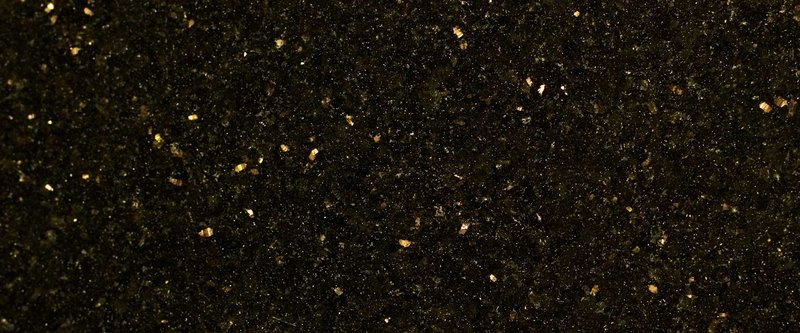
About Black Galaxy
Black Galaxy Granite is quarried exclusively from Cheemakurthy in Prakasam District, Andhra Pradesh — a tightly defined quarrying zone that has supplied this stone to international markets for several decades. The quarry sits within the Deccan geological block on the eastern Deccan plateau, where the specific mafic intrusion that produces the Galaxy character is confined to a limited geographic area. Every consignment is graded and inspected before shipment to ensure fleck density and colour uniformity meet export standards. FOB Mundra / Nhava Sheva. Origin and specifications verified by Gemarix.
Geological Profile
Black Galaxy is petrologically a fine-grained mafic gabbro, not a granite in the strict mineralogical sense, but universally traded as black granite. The matrix comprises augite and bronzite (pyroxene minerals) as the dominant phase, with plagioclase feldspar, magnetite, and ilmenite as secondary minerals. It is the bronzite and ilmenite inclusions — with their high reflective index and specific crystallographic orientation — that produce the characteristic copper-gold metallic fleck pattern. The near-zero porosity makes the stone virtually impermeable and frost-resistant, suited to the most demanding interior and exterior specifications.
Color & Character
Black Galaxy Granite is defined by a deep, uniform jet-black base matrix distributed with small-to-medium copper and gold metallic flecks. The black field originates from the dense augite-bronzite-plagioclase mineralogy with almost no visible lighter mineral zones. The flecks are bronzite and ilmenite crystals whose reflective cleavage planes catch light individually, producing the starfield appearance the stone is named for. Fleck density varies naturally between blocks and consignments — standard grades show a moderate, even distribution; premium grades show higher fleck density with a more pronounced galaxy effect. On a polished surface, the contrast between the absolute black matrix and the metallic flecks is at its maximum, producing one of the most visually distinctive appearances in the natural stone market.
Best Applications
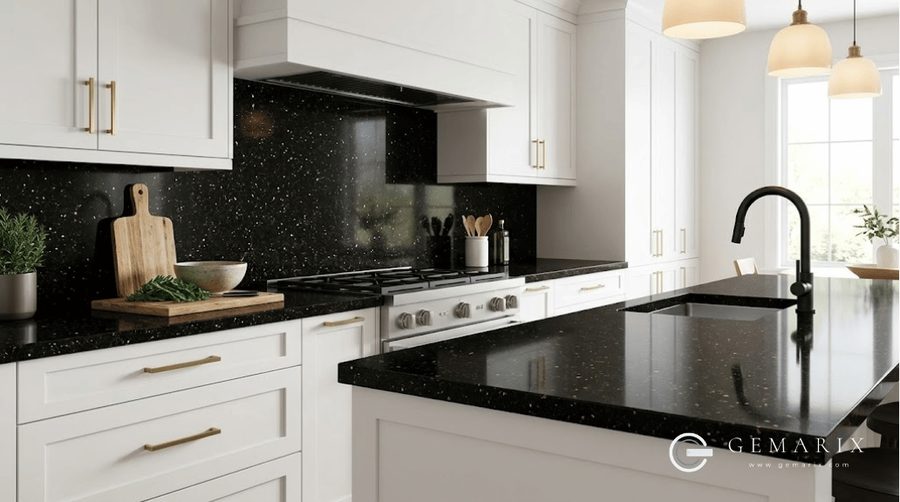
Kitchen Countertops
Near-zero porosity and extreme hardness make Black Galaxy one of the most practical choices for kitchen worktops — stain-resistant, heat-tolerant, and visually striking under kitchen lighting.
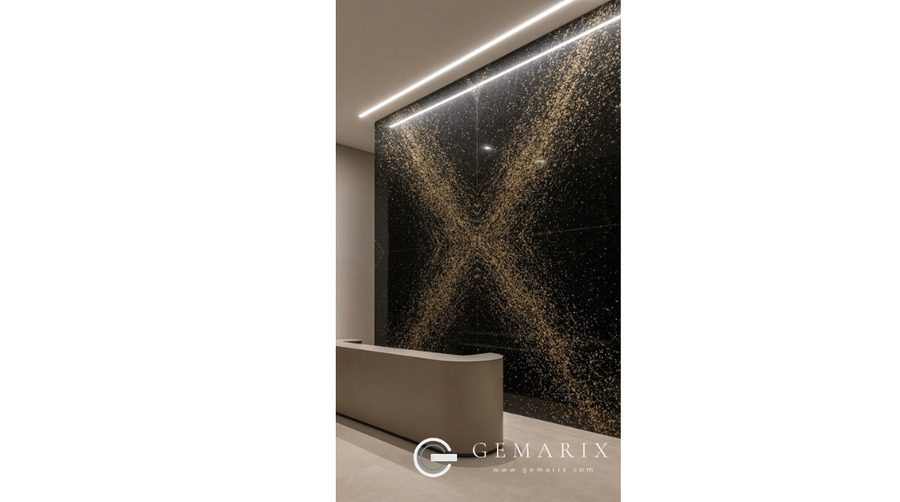
Wall Cladding
Polished or leathered panels create high-impact feature walls in hospitality lobbies, lift interiors, reception areas, and luxury residential interiors.
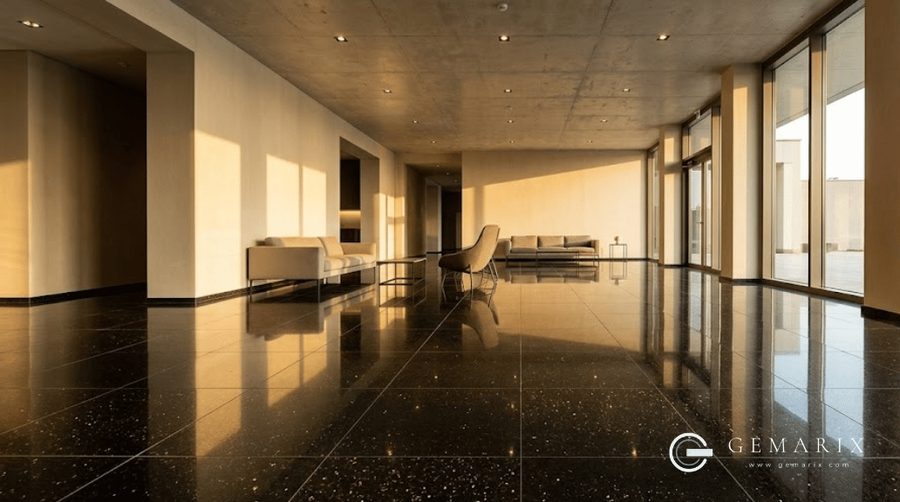
Flooring
Honed Black Galaxy provides excellent slip resistance for high-traffic floors while maintaining the dark depth of the stone. Supplied as calibrated tiles or gangsaw slabs for large-format installation.
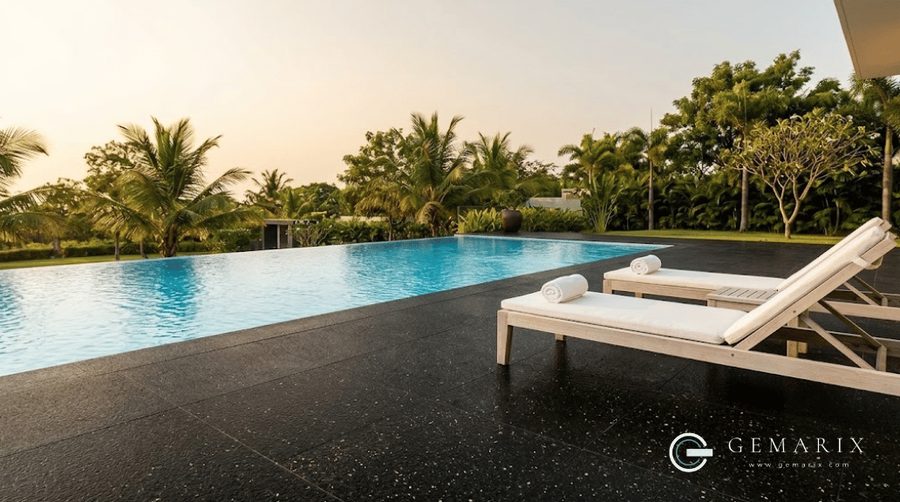
Exterior Facades
High compressive strength and frost resistance make Black Galaxy suitable for building cladding, column wraps, entrance steps, and outdoor paving in all climates.
Monuments
One of India's primary memorial stones — the uniform black ground and lasting polish make it the standard choice for monuments and memorials worldwide.
Commercial Interiors
Bathroom vanity tops, bar counters, retail display fixtures, and hospitality fit-outs where a premium black stone specification is required.
Available Finishes
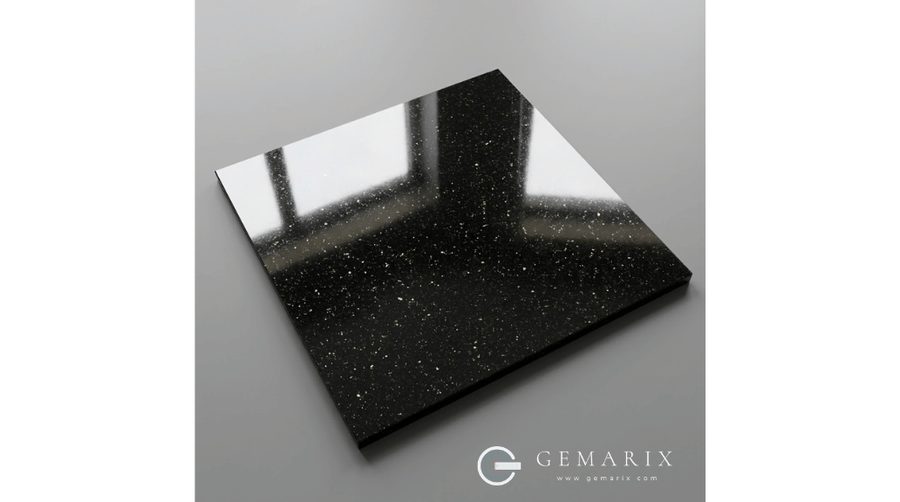
Polished
Mirror-bright finish that intensifies the metallic flecks and maximises colour contrast.
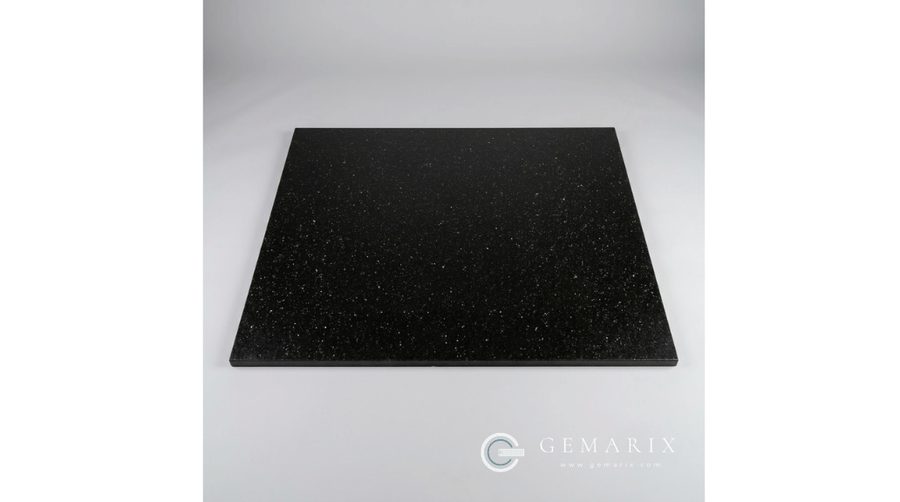
Honed
Matte, contemporary surface with softer fleck contrast. Good slip resistance for flooring.
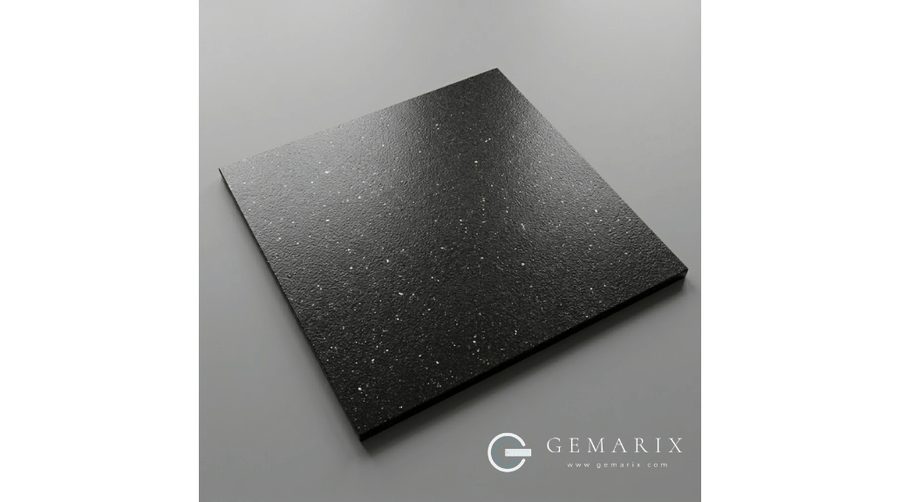
Leathered
Subtle micro-texture, ideal for premium kitchen surfaces and feature walls.
Brushed
Tactile finish with a refined natural feel, suited to exterior and heritage applications.
Available Sizes
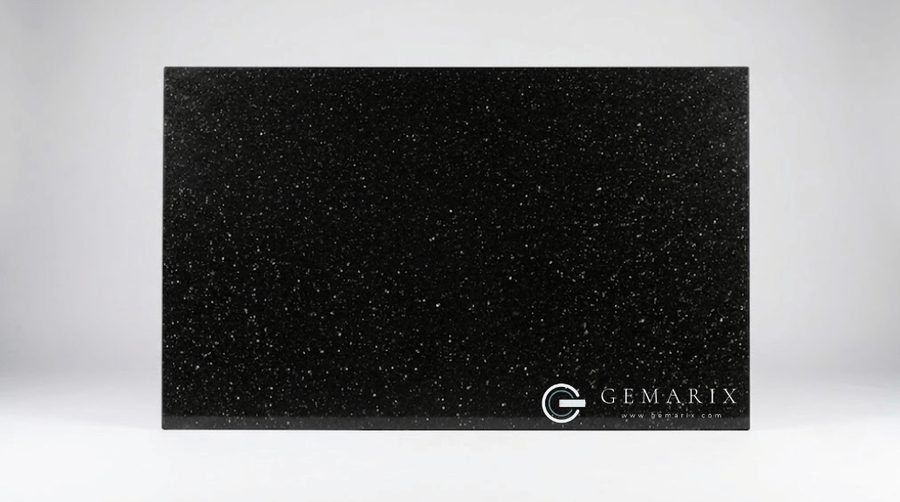
Gangsaw Slabs
up to 280 × 180 cm
Thickness: 18, 20, or 30 mm. Ideal for large-format countertops and continuous wall cladding.
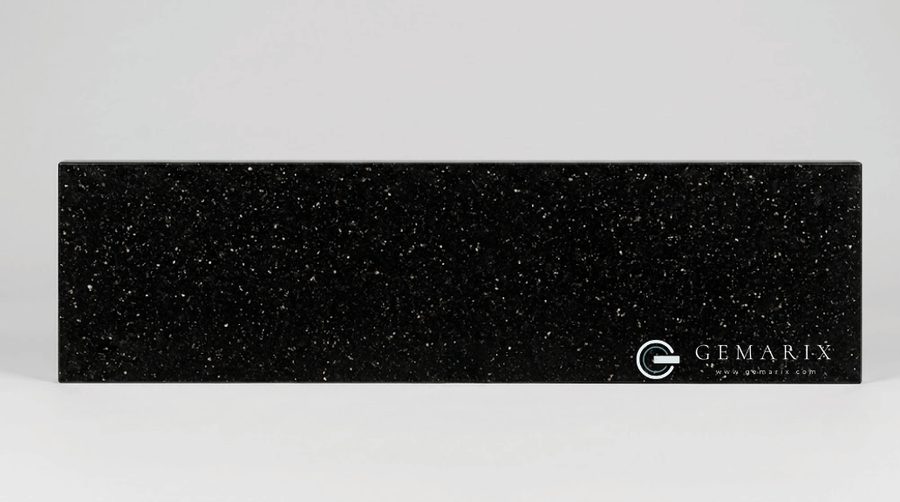
Cutter Slabs
up to 240 × 75 cm
Thickness: 16, 18, or 20 mm. Standard for kitchen vanity tops and commercial worktops.
Tiles
30×30, 30×60, 60×60 cm
Calibrated tiles for flooring and wall applications.
Custom Cuts
Cut-to-size
Bespoke dimensions available for export orders on request.
Care & Maintenance
Black Galaxy Granite requires minimal maintenance. Its near-zero porosity makes it highly resistant to staining without sealing in most commercial and exterior settings. For kitchen countertop use, a light penetrating impregnating sealer applied at installation and refreshed annually provides additional assurance. Clean with a pH-neutral stone cleaner and avoid bleach-based or highly acidic products on polished surfaces. Polished Black Galaxy retains its high-gloss finish for many years in normal use without re-polishing.
Request a Quote
Price on request. FOB Mundra / Nhava Sheva. MOQ and pricing vary by specification and destination. Contact us for availability, samples, and lead times.