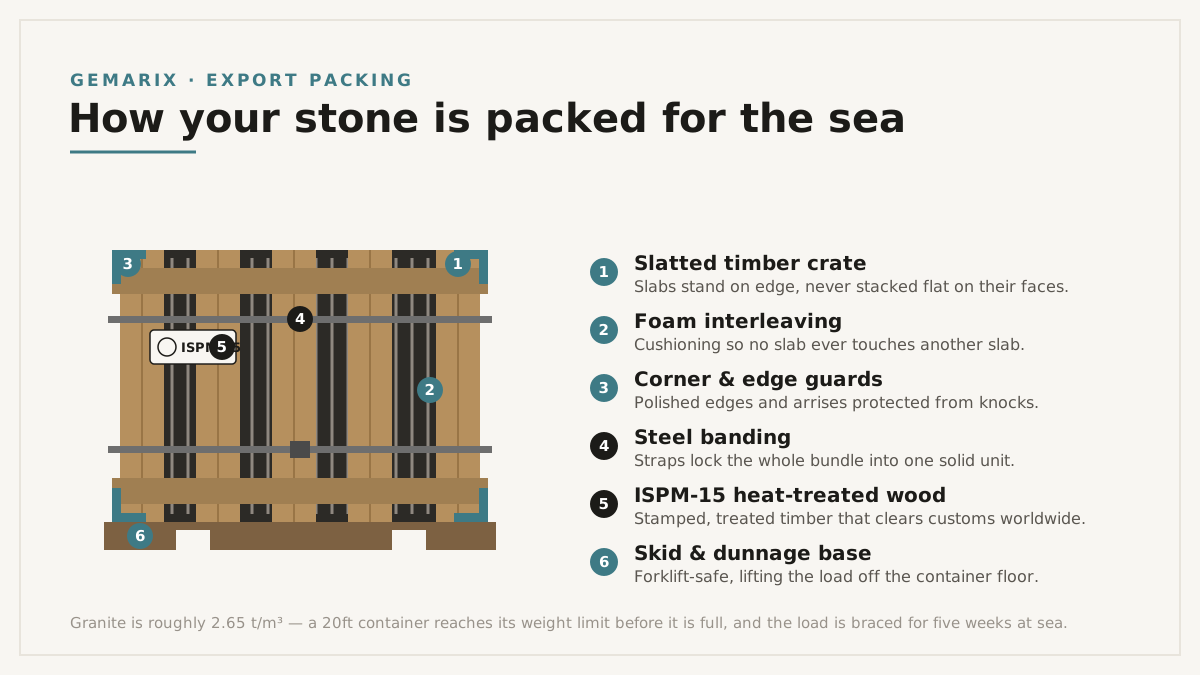
Stone is heavy and stone is brittle. Those two facts together are why natural stone export packing decides whether a container arrives as saleable material or as a claim. A slab that survives being cut, polished and moved across India can still be lost in the last twenty minutes of loading if it is packed badly. This guide covers how stone is physically protected for the voyage — the crates, the wood rules, the weight arithmetic and the biosecurity — and what a buyer should check when the doors finally open.
Two related guides sit either side of this one. How many monuments fit in a 20 ft container answers how much goes in. How to import natural stone from India covers the whole process end to end. This post is the detail on how the stone is protected.
Why packing is where the money is lost
A container of stone spends three to six weeks at sea. In that time it is lifted by crane several times, stacked, and moved by a ship that rolls and pitches continuously. Nothing inside is standing still.
Stone has a particular weakness. It is enormously strong in compression — you can stack a great deal of weight on it — and weak in bending. A slab supported at its ends with weight in the middle will crack. That single property drives almost every packing decision that follows.
And when damage does happen, the argument that follows is expensive out of proportion to the stone. Who pays, whether it was packing or handling, whether the insurance responds. Good packing is the cheapest insurance in the chain.
How each product is packed
There is no single method. What protects a slab would destroy a tile.
- Slabs — travel standing on edge, leaned at a slight angle against an A-frame, which is an A-shaped steel or timber frame that supports the bundle. Never flat: a flat slab flexes under the weight above it and cracks. Slabs are separated with soft interleaving so polished faces never touch, protected at edges and corners, banded tightly to the frame, and the frame itself is secured inside the container.
- Tiles — packed flat in wooden crates, usually foam-lined or with foam sheets between layers. Tiles are thinner and more fragile than slabs, and the crate has to be filled properly so nothing can move inside it. A half-empty crate is a broken crate.
- Blocks — raw quarry blocks weigh many tonnes each and are not crated. They ship in steel frames or on heavy timber bearers, and often travel in a 20 ft open-top container so a crane can lower them in from above.
- Monuments and cut-to-size — custom crates built around the piece, because a headstone or a carved panel has shapes and edges that a standard crate does not fit. Each piece is blocked so it cannot move within its crate, with the fragile detail protected.
The exact crate specification and materials should be confirmed against your order, since it varies with the product and the destination.
ISPM-15: the wood rules, not the stone rules
This is the compliance point that catches first-time importers, and the confusion is understandable: the rule is not about the stone at all. It is about the wood around it.
ISPM-15 is the international standard for wood packaging used in trade. It exists to stop timber pests travelling the world inside pallets and crates. Solid wood packaging — crates, pallets, dunnage, bracing — must be debarked and heat treated, then stamped with the IPPC mark. That stamp carries the country code, the treating facility’s code and the treatment code, and it must be visible on the wood.
Most markets require it. The European Union and Australia enforce it strictly, and the consequence of getting it wrong is severe: a container can be held at the port, ordered to be re-packed or treated, or in the worst case re-exported — all at the importer’s cost, with demurrage running the whole time.
Two practical notes. Manufactured wood such as plywood and OSB is processed in a way that takes it outside the ISPM-15 requirement, so some crating uses it deliberately. And if your crates use solid timber, ask to see a photograph of the stamp rather than taking it on trust — it is a five-second check that prevents a five-figure problem.
Dunnage, edges, banding and moisture
Four things do the actual protecting once the crate design is settled.
- Dunnage — the timber and packing material used to fill space and stop movement inside the container. Empty space is the enemy. A load that can shift will shift, and stone that has shifted has usually been damaged before it stopped.
- Edge and corner protection — corners are where stone chips first, and a chipped corner on a polished slab often means the piece cannot be used at full size. Cardboard or plastic angle protectors under the banding are standard.
- Banding — steel or heavy polyester straps holding the bundle to the frame and the frame to the container. Banding must be tight enough to hold and not so tight that it crushes an edge, which is a judgement made by the person doing it rather than a number on a spec sheet.
- Moisture control — a container crossing from India through the tropics goes through large temperature swings, and warm humid air condenses on cool steel. That water drips onto the cargo. Desiccant bags and correct wrapping manage it. Uncontrolled, it causes water staining on light stone and can rust steel banding onto the surface.
Light-coloured stone is the most vulnerable to moisture marking, which is worth remembering if you are importing a white marble such as Makrana or a pale granite like Kashmir Gold.
Weight, not volume: the arithmetic
Granite runs about 2.65 tonnes per cubic metre, and marble is close behind. That single number governs the whole loading plan, and it surprises nearly every first-time buyer.
A 20 ft container hits its payload limit long before it runs out of space. Load it correctly with slabs and it will look like there is room left, because there is — there is just no weight allowance left. This is why a supplier who quotes “a full container” without discussing tonnage is not thinking it through, and why loading is calculated rather than eyeballed.
Three consequences follow. Denser, darker stones reach the limit faster than lighter ones, so a container of Absolute Black holds less material than one of a lighter granite. Mixed-colour loads need the calculation done across the whole load, not per pallet. And road weight limits at the destination can be lower than the sea limit, so a container that is legal on the vessel may be over the limit on the truck — worth confirming with your haulier before you fix the load.
The same arithmetic applied to finished pieces is worked through in how many monuments fit in a 20 ft container.
Biosecurity for strict markets
Some countries care as much about what travels with the stone as about the stone itself.
Australia is the strictest. The Department of Agriculture, Fisheries and Forestry (DAFF) requires containers and goods to arrive clean: no soil, no seeds, no plant material, no insects, no animal matter, and ISPM-15 compliant wood. This matters more for stone than people expect, because stone comes out of the ground. A block that has been sitting in a quarry yard has soil on it, and quarry dust carries seeds. It has to be cleaned before packing, not after arrival.
A container that fails inspection in Australia is held for cleaning or fumigation at the importer’s cost, and the delay usually costs more than the cleaning does. New Zealand applies comparable standards, and the European Union enforces ISPM-15 rigorously even though its general biosecurity regime differs.
If Australia is your market, our post on the Australian engineered stone ban and granite benchtops covers the wider picture there.
Ask your supplier what their cleaning procedure is before packing rather than assuming one exists.
FCL or LCL: for stone, this is not a close call
FCL means a full container load, exclusively yours. LCL means less than container load — your crates share a container with other shippers’ cargo.
For stone, FCL wins in almost every case. In an LCL shipment the crates are handled several extra times at the consolidation warehouse and again at deconsolidation, they sit next to cargo you did not choose and cannot inspect, and the load cannot be braced as a single planned unit. Every extra handling is another chance for a heavy, brittle product to be dropped or crushed.
LCL still has a place: samples, a few crates of tile, a first small trial order. But for production quantities the freight saving is routinely wiped out by a single broken crate.
What to check when the container arrives
The most expensive mistake a buyer makes at this stage is signing a clean delivery receipt and inspecting afterwards. Once the receipt is signed clean, a claim becomes very hard to pursue.
- Check the seal number before it is cut and confirm it matches your documents. A seal number that does not match means the container has been opened in transit, and that changes everything about how you proceed.
- Photograph the load before anything moves. Doors open, load untouched. These are the photographs that settle a dispute, and they cannot be taken later.
- Look for movement. Crates out of position, broken or slack banding, timber that has split. Anything that shifted was taking impacts throughout the voyage.
- Look for water. Staining on crates, rust marks around steel banding, damp timber. Light stone shows condensation damage first.
- Check corners and edges first. That is where chipping shows, and it is the damage most often missed during a quick unload.
- Record damage on the delivery receipt before you sign it. Note it in writing, photograph it, and tell your supplier and your insurer the same day.
Compare what arrived against the pre-shipment photographs. Gemarix photographs every container before the doors are sealed for exactly this reason: it establishes what left the facility, so a disagreement becomes a matter of evidence rather than recollection. Our inspection process is set out on the quality control page, and our packing and loading section covers the operational detail.
Whether loading can be supervised or filmed on your behalf is worth asking about at order stage.
Frequently Asked Questions
What is ISPM-15 and do I need it? It is the international standard for wood packaging. Solid wood crates, pallets and dunnage must be debarked, heat treated and stamped with the IPPC mark. Most markets require it; the EU and Australia enforce it strictly.
Why is my 20 ft container only part full? Because stone loads to weight, not volume. At about 2.65 t/m³ the payload limit arrives well before the space runs out.
How are slabs packed? Standing on edge against an A-frame, never flat, with soft interleaving between faces, edge and corner protection, and banding to hold the bundle to the frame.
What does Australia require? Clean containers and goods — free of soil, seeds, plant material and insects — plus ISPM-15 compliant wood. Quarried stone must be cleaned before packing.
FCL or LCL? FCL for production quantities. LCL means extra handling of a heavy, brittle product, and one broken crate usually costs more than the freight saved.
What do I check on arrival? Seal number before cutting, photographs before anything moves, then banding, movement, water marks and corners. Record any damage on the delivery receipt before signing.
Ask how it will be packed, before you order
Packing is usually the last thing a buyer asks about and one of the first things that goes wrong. Ask the question at enquiry stage: how will this be crated, is the wood ISPM-15 stamped, how is the container loaded, and what will I be shown before the doors close. A supplier who answers those clearly is telling you something useful about the rest of their operation.
Tell us your destination, product and quantity and we will set out exactly how it will be packed and loaded — tell us what you need and we will quote against your actual shipment. For duty and paperwork by market, see our guide to import duty on Indian stone in 2026.